
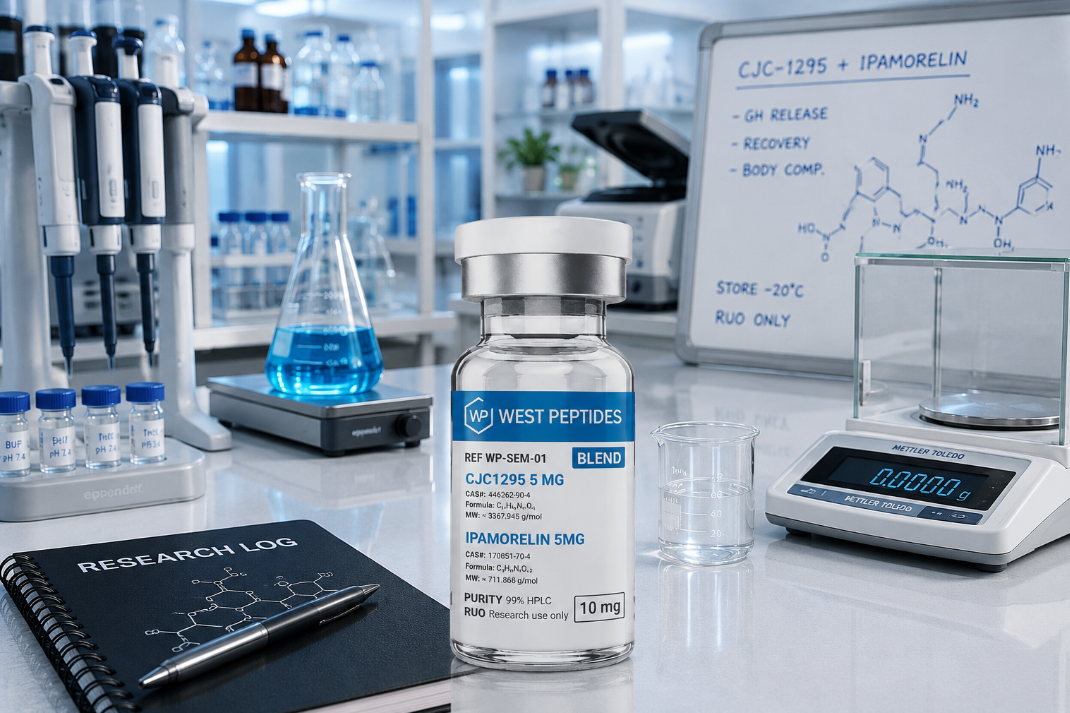
Ipamorelin and CJC-1295 are synthetic peptides classified as growth hormone secretagogues, studied for their ability to stimulate endogenous growth hormone (GH) release through distinct but complementary physiological pathways. Both compounds act at the level of the hypothalamic–pituitary axis, but differ in receptor targets, signaling mechanisms, pharmacokinetics, and downstream endocrine effects.
In research settings, these peptides are frequently examined independently and in combination to evaluate GH pulsatility, insulin-like growth factor 1 (IGF-1) modulation, and broader metabolic or regenerative signaling processes. A combined formulation is available here:
https://westpeptides.com/product/cjc-1295-10mg-no-dac-ipamorelin-10mg-blend/
CJC-1295 is a synthetic analog of growth hormone–releasing hormone (GHRH), derived from the first 29 amino acids of endogenous GHRH and modified to increase stability and half-life. It functions as a GHRH receptor agonist, stimulating GH release via pituitary somatotroph cells.
Ipamorelin is a synthetic pentapeptide classified as a growth hormone–releasing peptide (GHRP). It acts as a selective agonist of the growth hormone secretagogue receptor (GHS-R1a), also known as the ghrelin receptor.
Both compounds stimulate GH secretion but do so through non-overlapping receptor systems, which is central to their combined use in experimental models.
CJC-1295 binds to GHRH receptors on the anterior pituitary, activating adenylate cyclase and increasing intracellular cyclic AMP (cAMP), leading to GH secretion. This pathway mimics endogenous hypothalamic signaling and maintains physiological regulatory feedback via somatostatin and IGF-1.
The defining characteristic of CJC-1295 is its prolonged activity. Structural modifications, including drug affinity complex (DAC) in some forms, enable binding to albumin and significantly extend half-life, resulting in sustained GH release over several days.
This produces:
Ipamorelin binds to the GHS-R1a receptor, mimicking the endogenous hormone ghrelin. This activates phospholipase C signaling, increases intracellular calcium, and induces GH release through a mechanism independent of GHRH.
Unlike earlier GHRPs, Ipamorelin demonstrates high receptor selectivity, producing GH release without significant stimulation of cortisol, prolactin, or other pituitary hormones.
Ipamorelin produces:
The core mechanistic distinction lies in receptor engagement:
GHRH receptor activation follows canonical hypothalamic signaling pathways, whereas ghrelin receptor activation represents an alternative route for GH stimulation.
This dual-pathway architecture is the basis for their combined use, as activation of both receptors produces greater GH output than either pathway alone.
CJC-1295 produces sustained GH elevation due to its extended half-life. In clinical pharmacology studies, GH levels can remain elevated for several days following a single administration.
This results in:
Ipamorelin produces short, discrete GH pulses, typically lasting several hours.
Characteristics include:
This pulsatile release more closely resembles natural GH secretion but lacks sustained elevation.
The prolonged half-life is achieved through albumin binding, which protects the peptide from enzymatic degradation.
The pharmacokinetic contrast between the two compounds is substantial and directly influences their clinical and experimental roles.
Elevated IGF-1 is a key downstream effect, contributing to:
Its endocrine profile is narrower but more controlled.
When used together, CJC-1295 and Ipamorelin produce a “pulse and sustain” effect:
This combination enhances both frequency and amplitude of GH secretion, leading to more physiologic pulsatility combined with sustained exposure.
Mechanistically, synergy occurs because:
The result is greater GH output than either compound alone.
CJC-1295 has been investigated in:
Its prolonged activity makes it suitable for research involving:
Ipamorelin is studied in:
Its rapid action allows precise control of GH timing in experimental protocols.
The combination is frequently used in research contexts involving:
The complementary pharmacokinetics and mechanisms make this pairing a standard model for dual-pathway GH stimulation.
This specificity distinguishes Ipamorelin from earlier GHRPs.
| Feature | CJC-1295 | Ipamorelin |
|---|---|---|
| Receptor Target | GHRH receptor | Ghrelin receptor (GHS-R1a) |
| Mechanism | Mimics GHRH | Mimics ghrelin |
| GH Release Pattern | Sustained | Pulsatile |
| Half-life | Long (days) | Short (hours) |
| IGF-1 Elevation | Significant | Moderate |
| Endocrine Specificity | Broad GH axis | Highly selective |
| Primary Role | Baseline GH elevation | Pulse initiation |
CJC-1295 functions as a signal amplifier, increasing overall GH output over time.
Ipamorelin functions as a pulse trigger, initiating discrete GH release events.
This distinction is critical in experimental design:
Despite these limitations, both peptides remain widely studied due to their distinct and complementary mechanisms.
CJC-1295 is a GHRH analog that stimulates sustained GH release, while Ipamorelin is a ghrelin receptor agonist that produces short GH pulses.
They activate separate pathways within the GH axis, resulting in additive or synergistic GH release.
It demonstrates high selectivity and does not significantly increase cortisol or prolactin levels in most studies.
CJC-1295 produces more sustained IGF-1 elevation due to prolonged GH stimulation.
No. Their pharmacokinetics, receptor targets, and endocrine profiles differ significantly.
Combination allows simultaneous activation of both GHRH and ghrelin pathways, increasing GH pulsatility and total output.