
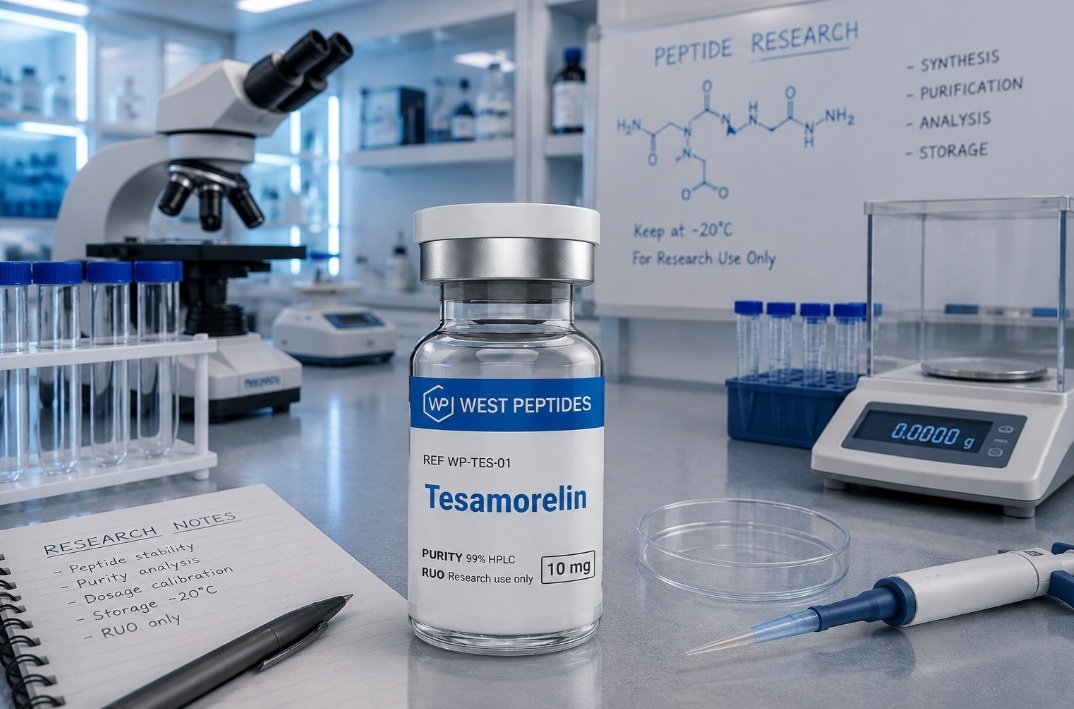
Tesamorelin and Ipamorelin are synthetic peptide compounds studied within the context of growth hormone (GH) axis modulation. Both are classified as growth hormone secretagogues, but they differ significantly in receptor interaction, signaling pathways, pharmacokinetics, and clinical research applications. These distinctions are relevant in experimental models examining endocrine regulation, metabolic signaling, and hypothalamic–pituitary function.
Tesamorelin is a stabilized analog of growth hormone–releasing hormone (GHRH), designed to act at the level of the pituitary through GHRH receptor activation. Ipamorelin, in contrast, is a selective ghrelin receptor (GHS-R1a) agonist that stimulates growth hormone release through a different signaling pathway. While both compounds ultimately influence GH secretion, their mechanisms of action, downstream effects, and regulatory profiles are not interchangeable.
For reference formulations, see:
Tesamorelin is a synthetic analog of endogenous GHRH, modified to improve stability and resistance to enzymatic degradation. It binds to GHRH receptors located on somatotroph cells in the anterior pituitary, stimulating cyclic AMP (cAMP) production and promoting pulsatile growth hormone release.
Because Tesamorelin acts upstream in the hypothalamic–pituitary axis, it preserves physiological feedback mechanisms, including somatostatin-mediated inhibition and insulin-like growth factor 1 (IGF-1) regulation. This results in a more physiologically patterned GH secretion profile compared to direct agonists.
In clinical research, Tesamorelin has been evaluated in models involving visceral adipose tissue regulation, metabolic signaling, and endocrine dysfunction, particularly in populations with altered GH dynamics.
Ipamorelin is a pentapeptide that selectively binds to the growth hormone secretagogue receptor (GHS-R1a), also known as the ghrelin receptor. Activation of this receptor stimulates GH release independently of GHRH signaling.
Unlike earlier ghrelin mimetics, Ipamorelin demonstrates high selectivity, with minimal interaction with receptors associated with cortisol or prolactin release. This receptor specificity is a defining characteristic in comparative research.
Ipamorelin-induced GH release is also pulsatile but occurs through a ghrelin-mediated pathway, which can operate independently of endogenous GHRH levels. This distinction is relevant in studies where hypothalamic signaling may be impaired or bypassed.
The primary distinction between these compounds lies in receptor engagement:
GHRH receptor activation leads to cAMP-mediated intracellular signaling and downstream GH secretion. This pathway is closely integrated with hypothalamic regulation and somatostatin feedback.
Ghrelin receptor activation, in contrast, involves phospholipase C (PLC) signaling, intracellular calcium mobilization, and alternative GH release pathways. This mechanism is less dependent on hypothalamic input and may function even when GHRH signaling is suppressed.
These differences are critical in experimental design, particularly when studying endocrine redundancy or compensatory signaling mechanisms.
Tesamorelin has been engineered for increased half-life relative to native GHRH. Structural modifications reduce susceptibility to dipeptidyl peptidase-IV (DPP-IV) degradation, allowing for sustained receptor interaction following administration.
In clinical studies, Tesamorelin demonstrates predictable pharmacokinetics with measurable increases in circulating GH and IGF-1 levels over defined intervals. Its activity is closely tied to intact pituitary responsiveness.
Ipamorelin has a shorter half-life compared to Tesamorelin but exhibits rapid receptor binding and activation. Its pharmacokinetic profile supports transient GH pulses, which may be advantageous in experimental models requiring controlled or repeatable stimulation.
Due to its receptor selectivity, Ipamorelin does not significantly alter cortisol or prolactin levels in most controlled settings, distinguishing it from less selective GHS analogs.
Tesamorelin and Ipamorelin both influence the GH–IGF-1 axis but differ in broader endocrine interactions.
Tesamorelin maintains alignment with endogenous regulatory systems. Its effects are modulated by somatostatin, IGF-1 feedback, and hypothalamic signaling inputs. This results in a profile that closely mimics physiological GH release patterns.
Ipamorelin, while still subject to feedback inhibition, operates through a parallel pathway. Its activity is less dependent on hypothalamic GHRH output and may produce GH release even in conditions of reduced endogenous stimulation.
Importantly, Ipamorelin has minimal observed impact on:
This receptor selectivity is a key differentiator in comparative endocrine studies.
Tesamorelin has been evaluated extensively in clinical research settings, particularly in studies involving:
It has regulatory approval in specific clinical contexts, which distinguishes it from many other GH secretagogues.
In research environments, Tesamorelin is often used to examine:
Ipamorelin is primarily used in preclinical and investigational research settings. Its applications include:
Because of its selective receptor profile, Ipamorelin is frequently used to isolate ghrelin-mediated effects without confounding hormonal responses.
Tesamorelin operates within the GHRH-mediated axis, preserving hypothalamic–pituitary integration. Ipamorelin activates a parallel ghrelin-dependent pathway, providing an alternative mechanism for GH release.
Tesamorelin is tightly regulated by physiological feedback systems. Ipamorelin is also subject to feedback inhibition but is less dependent on upstream hypothalamic signaling.
Tesamorelin primarily influences GH and IGF-1. Ipamorelin demonstrates high specificity for GH release with minimal off-target endocrine effects.
Tesamorelin has a longer duration due to structural stabilization. Ipamorelin produces shorter, more transient GH pulses.
Tesamorelin is often used in studies requiring sustained endocrine modulation. Ipamorelin is preferred in models requiring selective, short-acting GH stimulation.
In some experimental designs, Tesamorelin and Ipamorelin are studied in combination. The rationale is based on complementary pathway activation:
Simultaneous activation may produce additive or synergistic effects on GH release by engaging both primary regulatory mechanisms.
Such combinations are used to investigate:
However, these approaches are typically confined to controlled research environments and require careful protocol design.
Tesamorelin has undergone formal clinical evaluation and has received regulatory approval for specific medical indications. Its safety profile is documented within defined clinical populations.
Ipamorelin, by contrast, remains an investigational compound and is not approved for general medical use. It is primarily studied in laboratory and preclinical settings.
Both compounds should be understood within the context of controlled research. Variability in formulation, dosing, and experimental conditions can significantly influence outcomes.
Tesamorelin is a GHRH analog that stimulates GH release via pituitary receptors, while Ipamorelin is a ghrelin receptor agonist that induces GH release through a separate signaling pathway.
Both compounds can increase GH levels, which may lead to increased IGF-1 production in research models. However, Tesamorelin has more consistent IGF-1 elevation due to its upstream mechanism.
Ipamorelin is more receptor-selective, particularly in avoiding cortisol and prolactin stimulation. Tesamorelin is selective for the GHRH receptor but operates within a broader endocrine feedback system.
They target different receptors within the GH axis. Studying them together allows researchers to evaluate combined pathway activation and potential synergistic effects.
No. Despite both influencing GH secretion, their mechanisms, pharmacokinetics, and endocrine profiles differ significantly.
Tesamorelin has regulatory approval in specific contexts. Ipamorelin remains investigational and is not approved for general clinical use.