
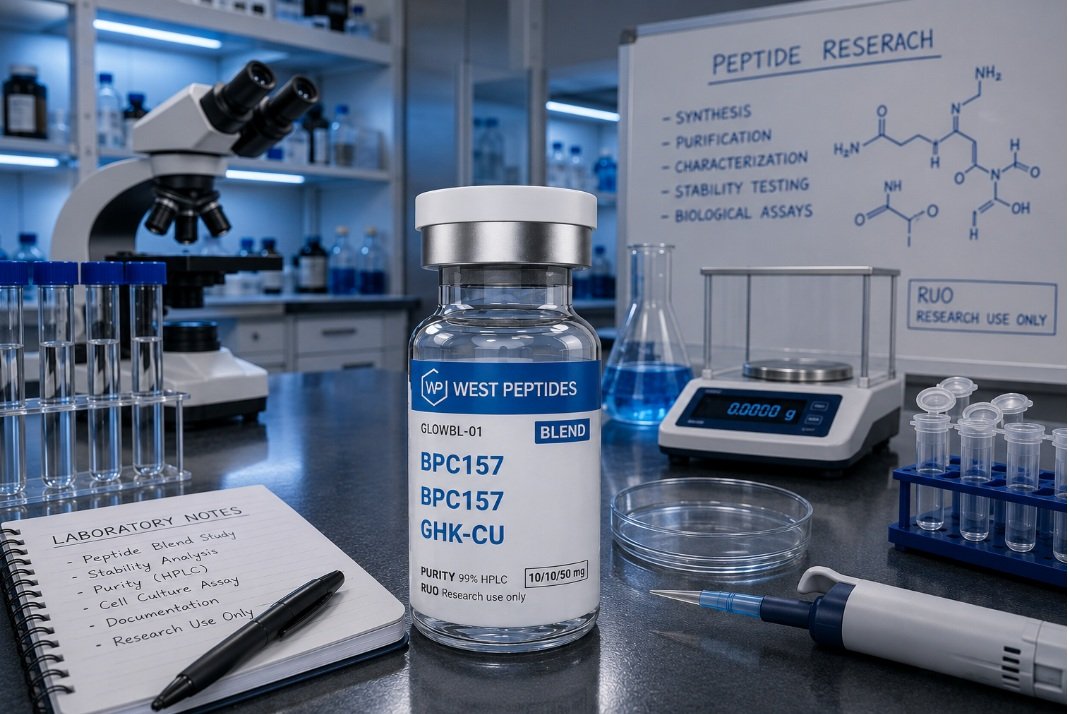
The Glow Blend peptide has become a focal point in modern peptide research due to its multi-pathway design and its ability to combine several well-studied signaling systems into a single investigational compound. Rather than focusing on a single biological mechanism, Glow Blend is structured to support research into cellular repair, collagen dynamics, angiogenesis, and tissue-level signaling integration.
At its core, Glow Blend is a combination of three peptides—GHK-Cu, BPC-157, and TB-500—each of which has been independently studied for its role in regenerative and cytoprotective processes. When combined, these peptides create a model system for studying how multiple biological pathways interact simultaneously in controlled environments.
Researchers often use blends like this to better understand how signaling networks overlap, amplify, or regulate each other—particularly in models involving tissue stress, recovery, and extracellular matrix remodeling.
Glow Blend is a composite research peptide formulation that integrates three distinct compounds into a single experimental framework. The formulation is typically structured in a ratio emphasizing GHK-Cu for collagen and skin-related pathways, alongside BPC-157 and TB-500 for tissue and cellular repair signaling.
Unlike single peptides, Glow Blend is not designed to isolate one pathway. Instead, it allows researchers to examine how multiple systems—vascular, structural, and cellular—interact simultaneously.
For those exploring individual components, you can review:
Glow Blend consists of three well-known research peptides, each contributing a different function:
GHK-Cu is widely studied for its role in collagen production, gene expression, and tissue remodeling. Research suggests it influences a large number of genes involved in repair and regeneration, particularly in skin-related models.
BPC-157 is a gastric-derived peptide studied for its interaction with angiogenesis, nitric oxide signaling, and tissue repair pathways. It has been explored in models involving muscle, tendon, and connective tissue recovery.
TB-500 is investigated for its role in cell migration, actin regulation, and tissue remodeling, making it relevant in studies of wound healing and structural recovery.
What makes Glow Blend particularly interesting is not just the presence of these peptides—but how they interact together.
Instead of targeting one biological process, Glow Blend allows researchers to study:
This makes it especially useful in complex biological models, where multiple pathways are active simultaneously.
There is often confusion around peptide blends like Glow Blend, particularly regarding their purpose.
Misconception 1: It’s just a “stronger” version of one peptide
In reality, Glow Blend is not about potency—it’s about pathway diversity. Each peptide contributes a unique signaling mechanism.
Misconception 2: All peptides do the same thing
Each component operates in different domains:
Misconception 3: Blends are redundant
Research suggests that combining peptides may allow for complementary or synergistic interactions, rather than duplication of function.
BPC-157 has been studied in experimental models for its ability to support angiogenic signaling and tissue stability, particularly in environments involving injury or stress.
TB-500 is associated with cell migration and structural repair, helping researchers understand how tissues reorganize and recover at a cellular level.
GHK-Cu is often used in studies examining collagen production, extracellular matrix remodeling, and skin-related signaling pathways.
The key advantage of Glow Blend lies in multi-pathway engagement.
Instead of acting independently, these peptides create a system where:
can be observed together within the same experimental model.
This allows researchers to examine integrated biological responses, rather than isolated effects—something increasingly important in advanced regenerative research.
Although Glow Blend itself is a composite formulation, its components are well studied individually. When combined, they are often used to explore:
Research indicates that combining these peptides allows for more comprehensive modeling of biological repair systems, especially in complex tissue environments.
Glow Blend is frequently explored in models related to:
GHK-Cu, in particular, has been shown to improve skin thickness, elasticity, and overall structure in controlled studies.
In research involving tissue stress or injury models, Glow Blend components are studied for:
BPC-157 and TB-500 are especially relevant here, as they are associated with repair and migration pathways.
Another major area of study involves inflammatory signaling and recovery dynamics.
Glow Blend allows researchers to examine:
In controlled environments, researchers may observe:
These timelines help illustrate how different pathways activate and interact over time.
Glow Blend is used in studies involving:
Researchers use Glow Blend to simulate environments involving:
This helps provide insight into how cells coordinate repair mechanisms.
In laboratory contexts, Glow Blend is also used to study post-stress or post-intervention recovery pathways, particularly those involving tissue remodeling.
Glow Blend is frequently explored in research related to:
At a deeper level, Glow Blend is used to examine:
Because Glow Blend is a research compound, proper protocols are essential:
Research outcomes can vary based on:
While promising, peptide research is still evolving. Limitations include:
Always use verified, high-purity research peptides to ensure reproducibility.
Lyophilized peptides should be stored according to recommended conditions to maintain stability.
Define variables, endpoints, and controls before beginning any study.
Reliable suppliers ensure consistency, purity, and proper documentation, which are critical for research integrity.
Glow Blend is a research peptide formulation combining GHK-Cu, BPC-157, and TB-500 to study multi-pathway biological signaling.
Each peptide targets a different system, allowing researchers to examine integrated cellular responses.
Its ability to engage multiple biological pathways simultaneously, rather than isolating a single mechanism.
No—Glow Blend is intended strictly for research and investigational use only.
Glow focuses on GHK-Cu, BPC-157, and TB-500, while KLOW Blend introduces additional peptides such as KPV for expanded pathway research.