
$59.99
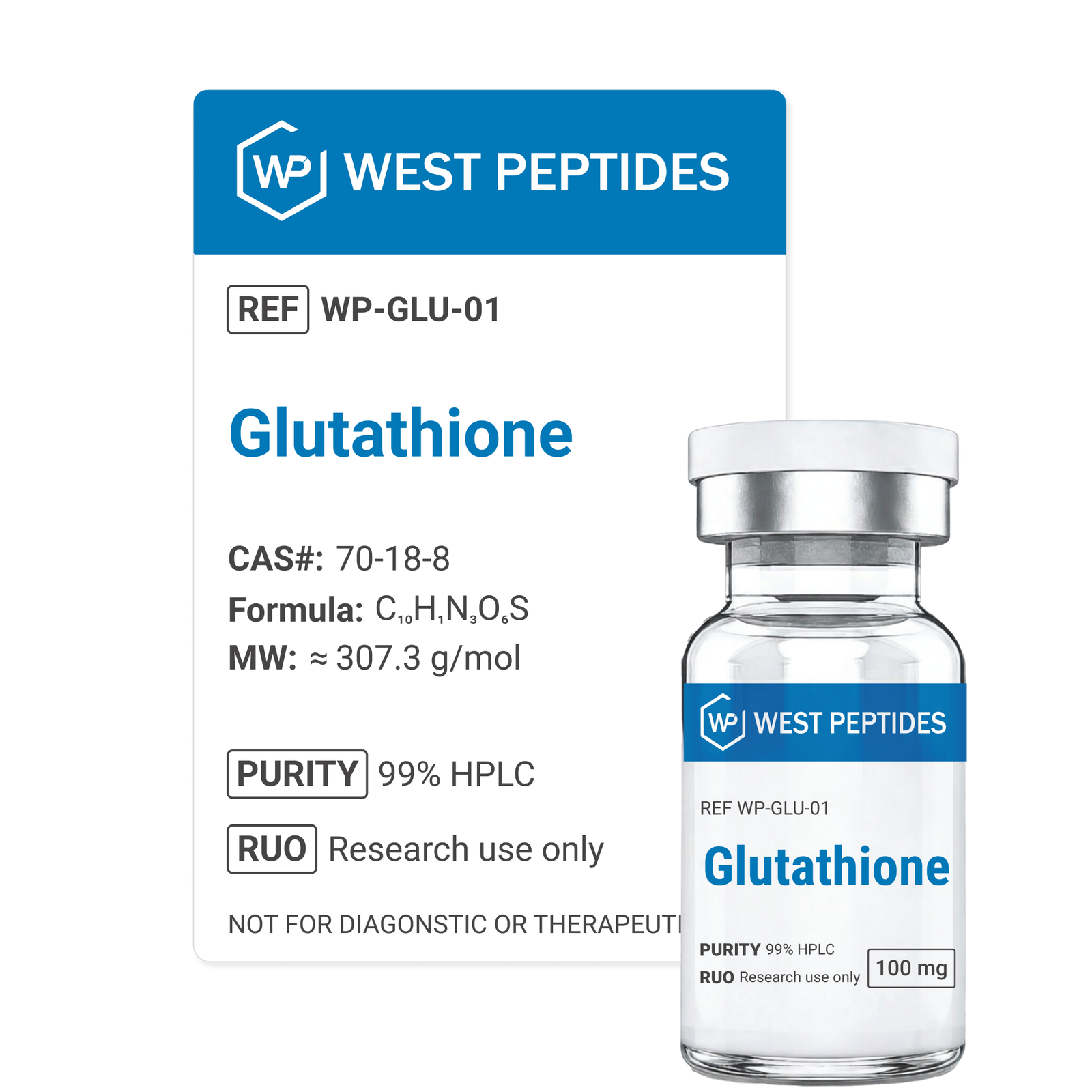
Glutathione is a naturally occurring tripeptide composed of three amino acids: glutamate, cysteine, and glycine. It is one of the most abundant intracellular molecules involved in cellular redox balance and biochemical regulation. Due to its central role in molecular homeostasis, glutathione is widely referenced across multiple areas of scientific and preclinical research. West Peptides supplies high-purity glutathione in solid form.
$59.99
Glutathione is a naturally occurring tripeptide composed of three amino acids: glutamate, cysteine, and glycine. It is one of the most abundant intracellular molecules involved in cellular redox balance and biochemical regulation. Due to its central role in molecular homeostasis, glutathione is widely referenced across multiple areas of scientific and preclinical research. West Peptides supplies high-purity glutathione in solid form.

Glutathione is a naturally occurring tripeptide composed of three amino acids: glutamate, cysteine, and glycine. It is one of the most abundant intracellular molecules involved in cellular redox balance and biochemical regulation. Due to its central role in molecular homeostasis, glutathione is widely referenced across multiple areas of scientific and preclinical research. West Peptides supplies high-purity glutathione in solid form.
Glutathione is provided as a white to off-white solid suitable for precise preparation in research environments. Its well-defined molecular structure allows it to be incorporated into experimental systems examining oxidative processes, enzymatic activity, and redox-sensitive pathways.
Because glutathione participates in fundamental biochemical reactions within cells, it is frequently used as a reference compound or investigative reagent in molecular biology research.
Within biological systems, glutathione exists primarily in two forms:
The balance between these two states plays an important role in maintaining cellular redox equilibrium. The reactive thiol group contained in the cysteine residue enables glutathione to participate in reversible oxidation-reduction reactions.
Researchers often examine glutathione dynamics when studying:
Its versatility and high intracellular concentration make it one of the most studied small molecules in cellular biochemistry.
Compound Type: Endogenous tripeptide
Composition: Glutamate, cysteine, glycine
Primary Forms Studied: Reduced (GSH) and oxidized (GSSG)
Appearance: White to off-white solid
Purity Standard: High analytical grade
Storage Stability: Maintains integrity under recommended laboratory storage conditions
Each batch is verified for purity and composition consistency to support reliable research applications.
Glutathione may be incorporated into structured research designs such as:
These applications reflect scientific contexts where defined molecular compounds are required to examine biochemical behavior under controlled conditions.
Well-Characterized Molecular Structure
Widely studied tripeptide involved in redox biology.
High Purity Verification
Manufactured and tested to meet analytical standards for research.
Versatile Research Utility
Suitable for incorporation into diverse experimental systems.
Research-Ready Packaging
Prepared for handling by qualified professionals in laboratory environments.
What is glutathione composed of?
Glutathione is a tripeptide consisting of glutamate, cysteine, and glycine arranged in a specific molecular sequence.
Why is glutathione important in scientific research?
Glutathione plays a central role in redox balance and cellular biochemical processes, making it a widely studied molecule in molecular and cellular biology research.
What is the difference between GSH and GSSG?
GSH refers to the reduced form of glutathione, while GSSG represents the oxidized form. The ratio between these two states is often examined in research related to oxidative processes.
Is this product naturally sourced or synthetic?
Research-grade glutathione is produced through controlled manufacturing processes to meet defined purity and quality standards.
How should glutathione be stored prior to use?
It should be stored in a cool, dry environment, protected from moisture and light, to maintain structural stability before preparation.
This product is intended strictly for laboratory research and scientific investigation purposes only. Glutathione is not approved by the United States Food and Drug Administration for human or veterinary use. It is not intended for use as a drug, dietary supplement, cosmetic, or food product.
Our products are produced using a freeze-drying process (lyophilization), which helps maintain their integrity and stability during transit, typically for up to 3–4 months.
After the peptides are reconstituted (mixed with bacteriostatic water), they should be kept refrigerated to preserve their quality. Once in liquid form, they generally remain stable for up to 30 days when stored properly.
Lyophilization—also referred to as cryodesiccation—is a dehydration method where the material is first frozen and then exposed to low pressure. This allows moisture to transition directly from solid to vapor, leaving behind a dry, stable compound in the form of a light, crystalline powder. In this state, the product can be kept at room temperature until it is ready to be reconstituted.
Upon receiving your peptides, it is recommended to protect them from heat and light exposure. For short-term use (ranging from a few days to several weeks), refrigeration below 4°C (39°F) is suitable. Lyophilized products can also tolerate room temperature storage for a limited period if they will be used relatively soon.
For extended storage—spanning several months or longer—freezing is advised. Ideally, peptides should be kept at approximately -80°C (-112°F) to best maintain long-term stability