
$99.99 Original price was: $99.99.$79.99Current price is: $79.99.
BUY ONE, GET ONE FREE
Add any quantity to your cart - we'll double it for free. Limited time offer.
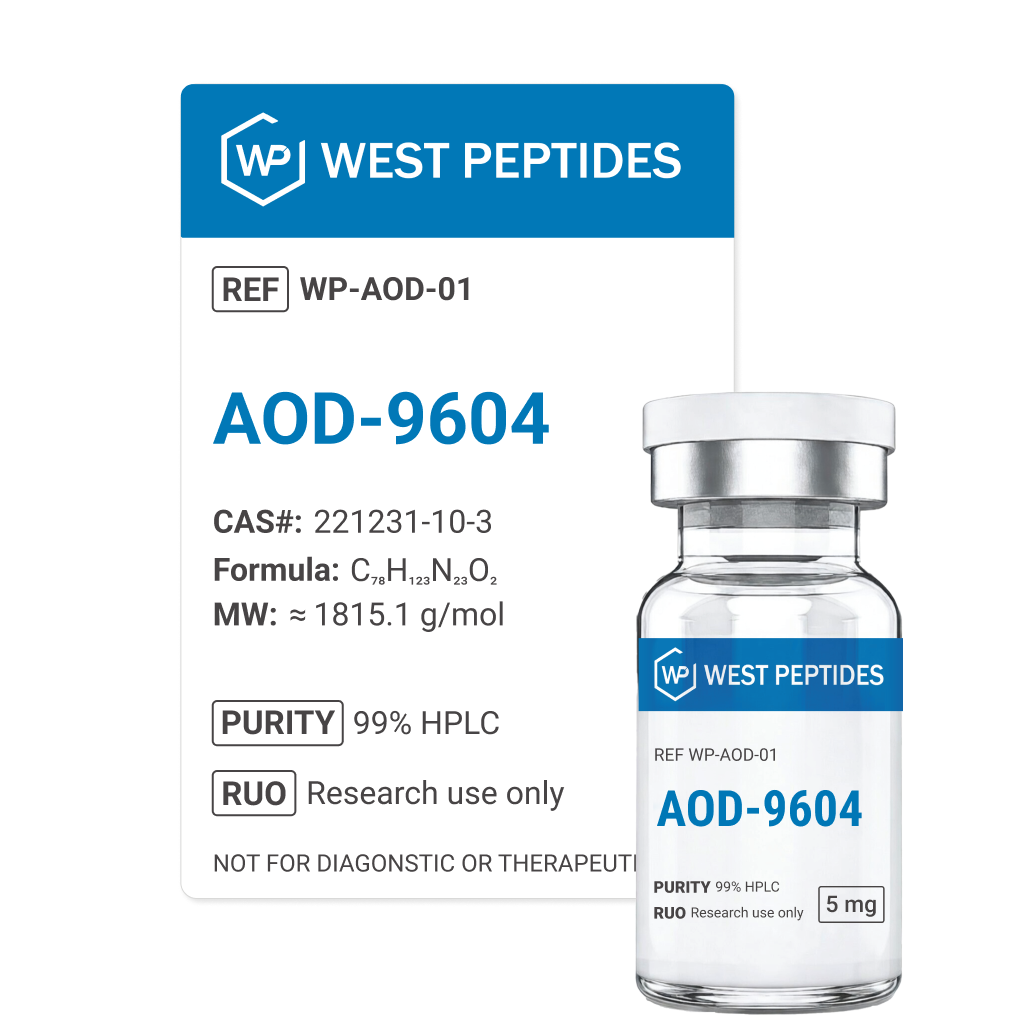
AOD-9604 is a synthetic peptide fragment derived from the carboxyl (C-terminal) region of the human growth hormone molecule. It represents a 16-amino-acid segment corresponding to the lipolytic domain of growth hormone and has been explored extensively in scientific and preclinical research models. West Peptides supplies high-purity AOD-9604 in a lyophilized format.
$99.99 Original price was: $99.99.$79.99Current price is: $79.99.
 Manufactured
AOD-9604 is a synthetic peptide fragment derived from the carboxyl (C-terminal) region of the human growth hormone molecule. It represents a 16-amino-acid segment corresponding to the lipolytic domain of growth hormone and has been explored extensively in scientific and preclinical research models. West Peptides supplies high-purity AOD-9604 in a lyophilized format.

Defined Peptide Fragment for Laboratory Investigation
AOD-9604 is a synthetic peptide fragment derived from the carboxyl (C-terminal) region of the human growth hormone molecule. It represents a 16-amino-acid segment corresponding to the lipolytic domain of growth hormone and has been explored extensively in scientific and preclinical research models. West Peptides supplies high-purity AOD-9604 in a lyophilized format.
AOD-9604 was originally developed during research efforts aimed at understanding how specific regions of the growth hormone molecule influence fat metabolism. The peptide represents the amino acid sequence 176-191 of growth hormone that was identified to have distinct metabolic effects in early laboratory studies.
Because of its specific structural design, AOD-9604 is referenced in scientific literature as a tool for investigating metabolic regulation, adipose tissue biology, and selective signaling pathways in controlled research environments.
In preclinical models involving controlled experimental systems, AOD-9604 has been shown to engage with biological pathways related to fat mobilization and lipid metabolism:
These mechanisms are still subject to ongoing scientific study and remain topics of exploration in laboratory research.
AOD-9604 is supplied by West Peptides as a lyophilized (freeze-dried) peptide powder to support stability and ease of preparation. The format is intended to preserve structural integrity and facilitate dissolution with appropriate sterile solvents in laboratory workflows.
Researchers interested in metabolic regulation, lipid biology, and peptide signaling may incorporate AOD-9604 into experimental protocols that examine:
This peptide fragment is suitable for use in controlled laboratory environments by qualified personnel.
Peptide Type: Synthetic peptide fragment
Sequence Basis: Human growth hormone C-terminal region (amino acids 176-191)
Form: White to off-white lyophilized powder
Purity: High analytical grade
Stability: Preserved under recommended laboratory storage conditions
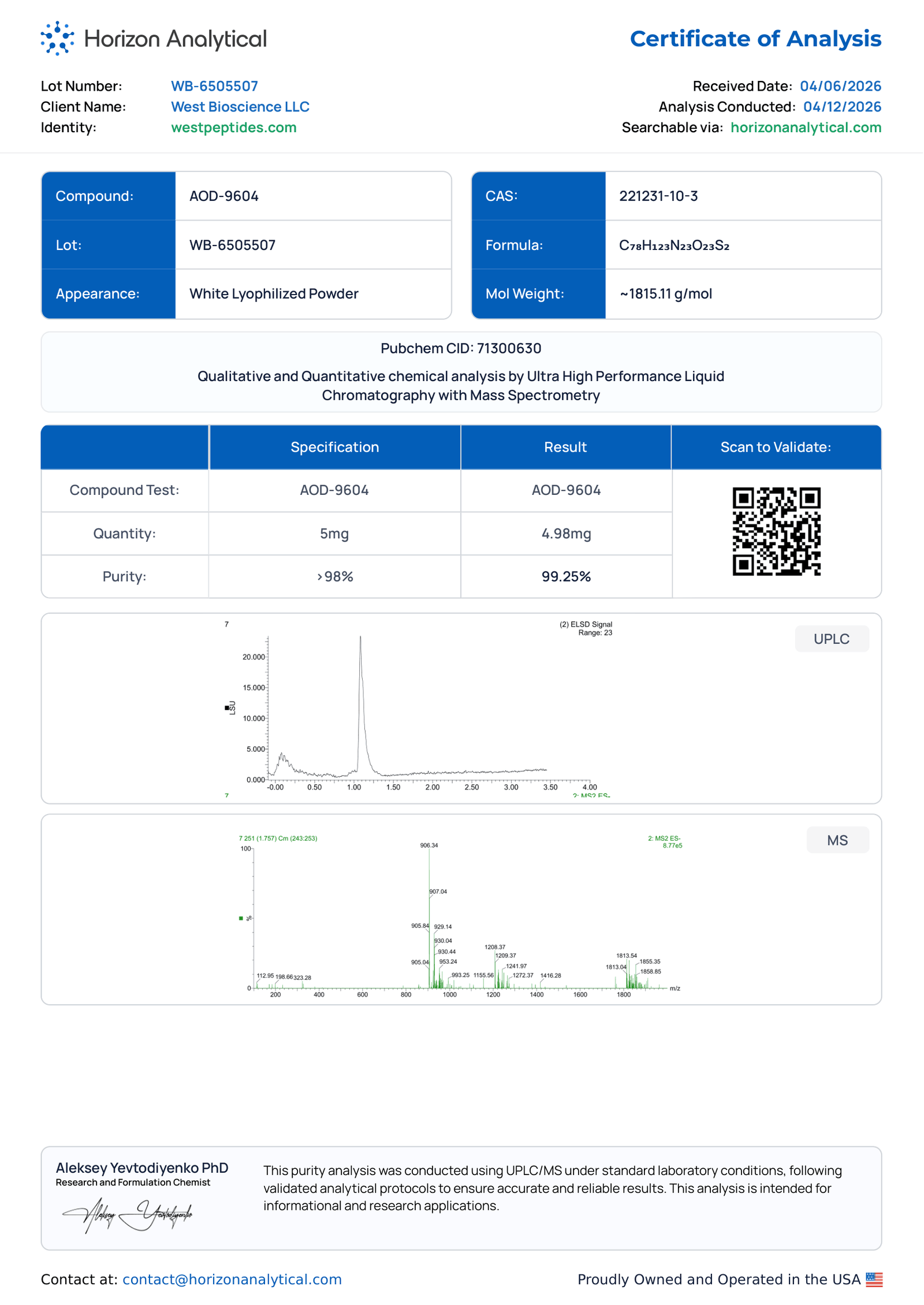
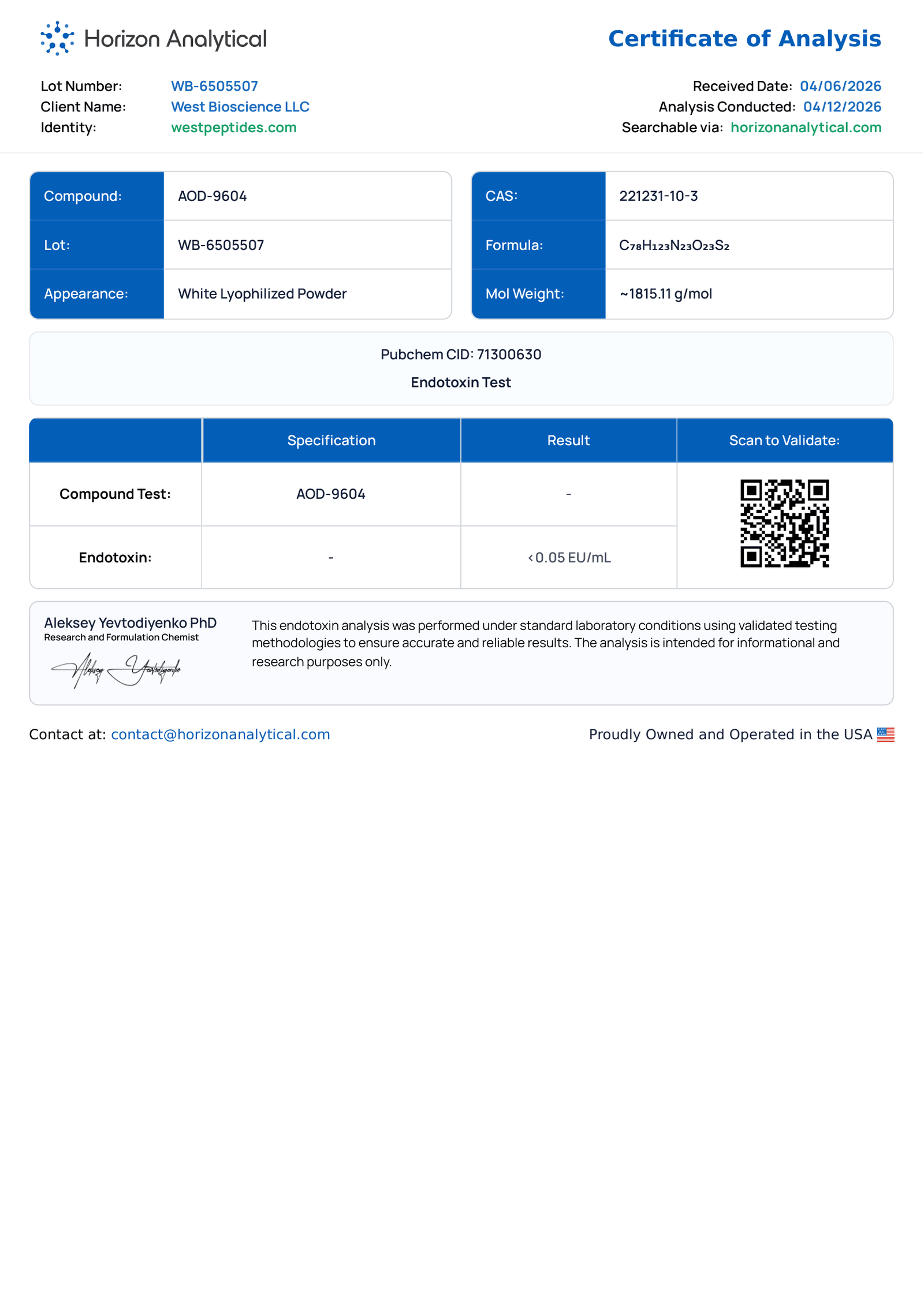
West Peptides verifies each batch for composition and purity to support reproducibility in research applications.
AOD-9604 may be employed in research studies that involve:
These applications reflect areas of scientific inquiry in which defined peptide fragments are used to probe molecular and cellular behavior.
What is AOD-9604?
AOD-9604 is a synthetic peptide fragment derived from the carboxyl end of the human growth hormone molecule. It is referenced in scientific studies related to fat metabolism and peptide signaling.
Why is this peptide fragment studied in research?
Researchers use AOD-9604 to explore how a defined sequence from growth hormone influences selective metabolic pathways and lipid biology in controlled models.
How is AOD-9604 supplied for research use?
West Peptides supplies AOD-9604 as a lyophilized powder that can be dissolved with appropriate sterile solvents for laboratory preparation.
Can the mechanisms of AOD-9604 be generalized?
While some laboratory studies show engagement with lipid metabolism pathways in animal models, these findings are specific to controlled research settings and do not imply clinical effects.
Why do researchers choose fragments rather than full-length hormones?
Peptide fragments such as AOD-9604 allow scientists to isolate and study sequence-specific interactions and signaling outcomes in experimental systems without the complexity of full-length hormones.
This product is intended strictly for scientific research and controlled laboratory investigation. AOD-9604 is not approved by the United States Food and Drug Administration or any other regulatory authority for human or veterinary use. It is not intended for use as a drug, dietary supplement, cosmetic, or food product.
Our products are produced using a freeze-drying process (lyophilization), which helps maintain their integrity and stability during transit, typically for up to 3–4 months.
After the peptides are reconstituted (mixed with bacteriostatic water), they should be kept refrigerated to preserve their quality. Once in liquid form, they generally remain stable for up to 30 days when stored properly.
Lyophilization—also referred to as cryodesiccation—is a dehydration method where the material is first frozen and then exposed to low pressure. This allows moisture to transition directly from solid to vapor, leaving behind a dry, stable compound in the form of a light, crystalline powder. In this state, the product can be kept at room temperature until it is ready to be reconstituted.
Upon receiving your peptides, it is recommended to protect them from heat and light exposure. For short-term use (ranging from a few days to several weeks), refrigeration below 4°C (39°F) is suitable. Lyophilized products can also tolerate room temperature storage for a limited period if they will be used relatively soon.
For extended storage—spanning several months or longer—freezing is advised. Ideally, peptides should be kept at approximately -80°C (-112°F) to best maintain long-term stability
A precision-driven journey from pharma-grade raw materials to your doorstep, ensuring the highest purity, stability, and quality at every stage.
From molecule to delivery — West Peptides