
$59.00 – $99.99Price range: $59.00 through $99.99
BUY ONE, GET ONE FREE
Add any quantity to your cart - we'll double it for free. Limited time offer.
BPC-157 is a 15–amino acid peptide originally identified in gastric compounds. It has been studied in research settings for its role in tissue repair processes involving muscles, tendons, ligaments, and skin.Research has also explored its interaction with protective mechanisms in organ systems and its involvement in maintaining digestive tract integrity. In gastrointestinal models, it has been associated with supporting the gut lining and cellular balance. Additionally, BPC-157 is investigated for its connection to circulation, collagen signaling, and pathways involved in tissue regeneration and recovery.
$59.00 – $99.99Price range: $59.00 through $99.99
 Manufactured
BPC-157 is a 15–amino acid peptide originally identified in gastric compounds. It has been studied in research settings for its role in tissue repair processes involving muscles, tendons, ligaments, and skin.Research has also explored its interaction with protective mechanisms in organ systems and its involvement in maintaining digestive tract integrity. In gastrointestinal models, it has been associated with supporting the gut lining and cellular balance. Additionally, BPC-157 is investigated for its connection to circulation, collagen signaling, and pathways involved in tissue regeneration and recovery.
BPC-157 is a 15–amino acid peptide originally identified in gastric compounds. It has been studied in research settings for its role in tissue repair processes involving muscles, tendons, ligaments, and skin.Research has also explored its interaction with protective mechanisms in organ systems and its involvement in maintaining digestive tract integrity. In gastrointestinal models, it has been associated with supporting the gut lining and cellular balance. Additionally, BPC-157 is investigated for its connection to circulation, collagen signaling, and pathways involved in tissue regeneration and recovery.
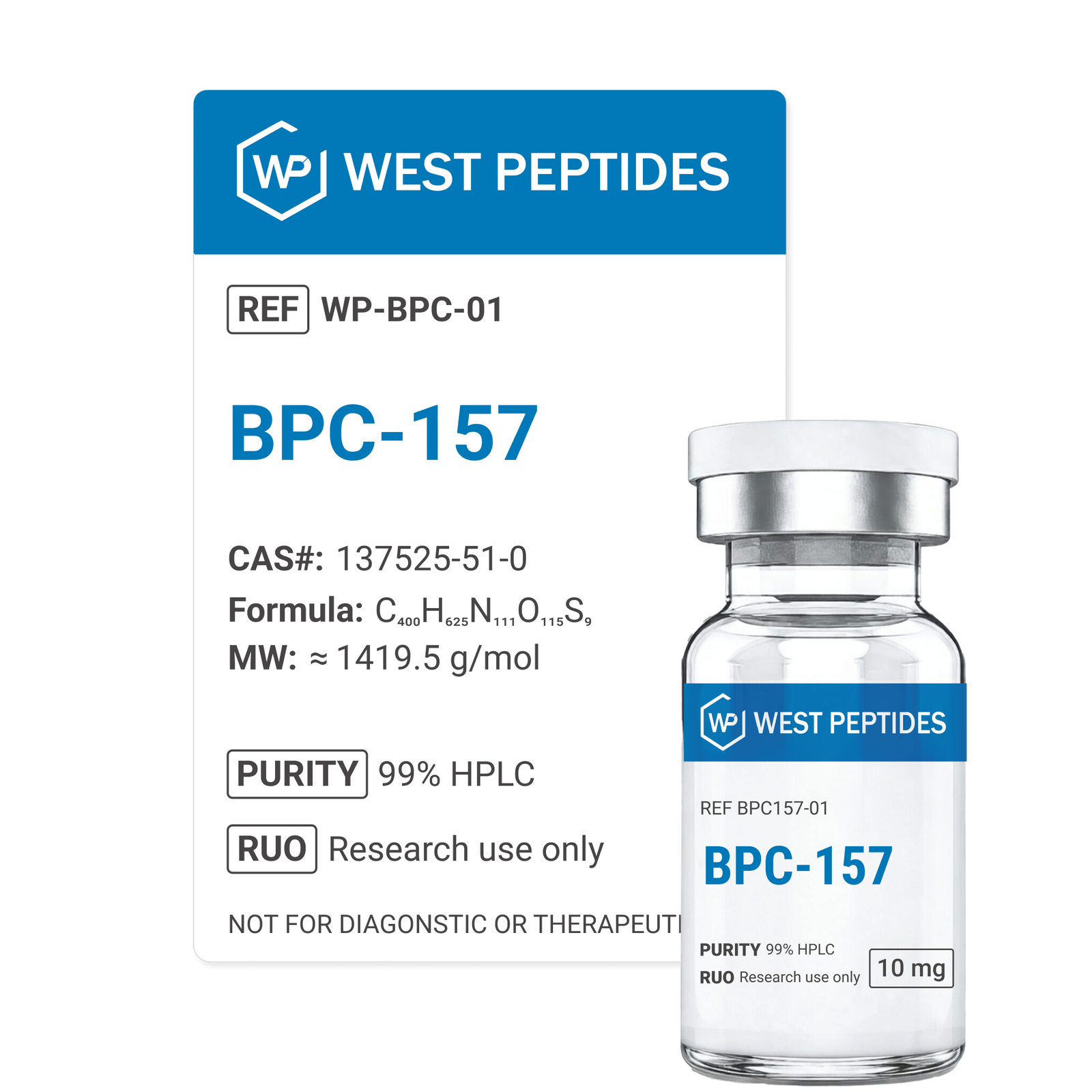
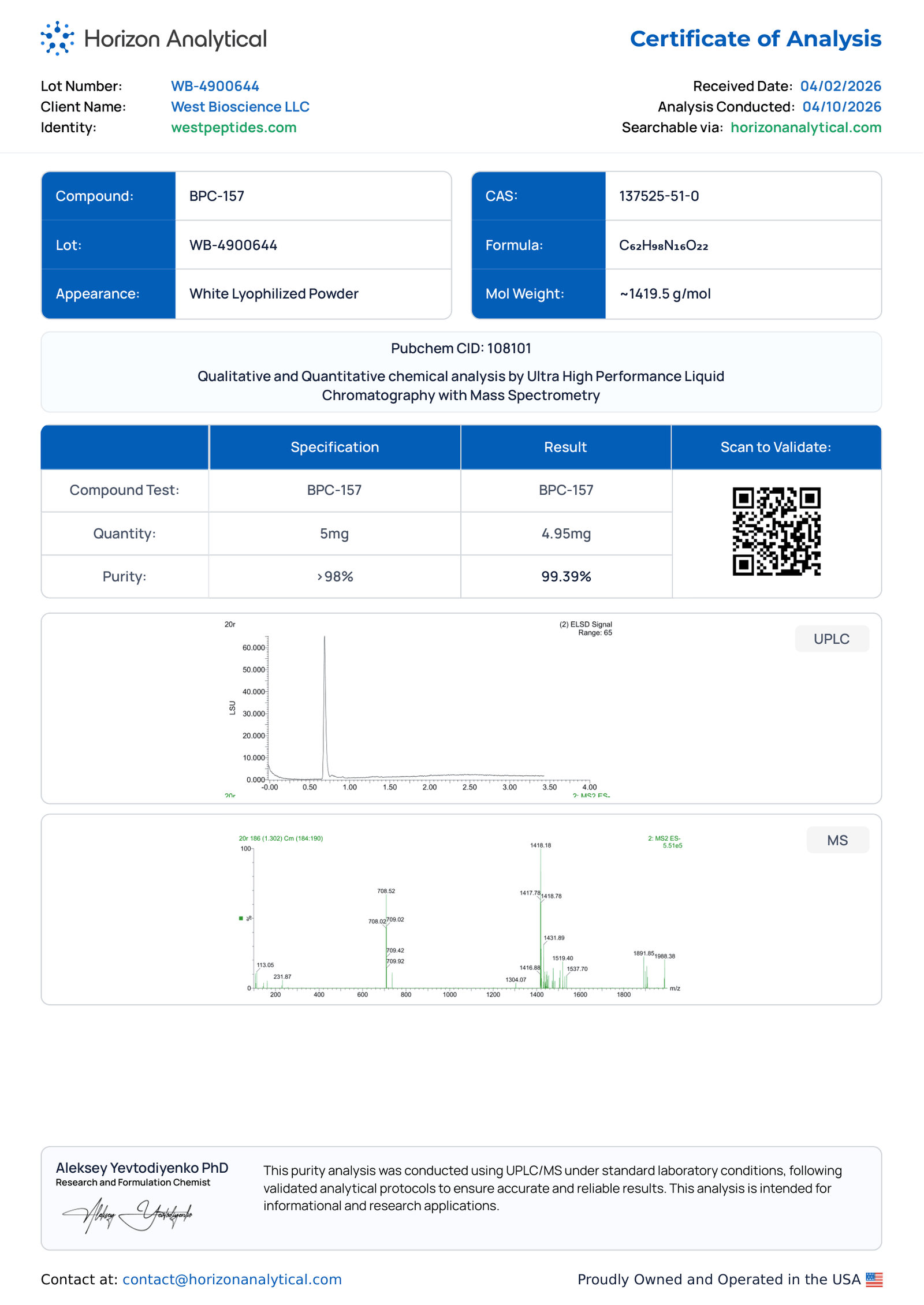
West Peptides supplies BPC-157 as a high-purity, lyophilized peptide.
BPC-157 has been the subject of extensive scientific interest in preclinical research settings. Its distinct molecular profile has made it a commonly studied peptide in laboratories exploring cellular signaling and tissue biology.
In controlled experimental models, BPC-157 has been investigated in relation to:
These studies contribute to a growing body of scientific knowledge about how specific peptide structures interact with biological systems under research conditions.
Peptide Type: Pentadecapeptide (15 amino acids)
Amino Acid Sequence: Gly-Glu-Pro-Pro-Pro-Gly-Lys-Pro-Ala-Asp-Asp-Ala-Gly-Leu-Val
Approximate Molecular Weight: 1419.5 g/mol
Form: White, lyophilized powder
Stability: Demonstrates structural stability in standard laboratory environments
At West Peptides, product integrity and consistency are fundamental. Our BPC-157 is:
We design our products to support experimental consistency and scientific investigation.
What is BPC-157?
BPC-157 is a synthetic peptide researched in laboratory and preclinical models. It features a specific 15 amino acid sequence and is widely used in controlled scientific investigation.
Why is BPC-157 studied in research environments?
Researchers use BPC-157 to explore aspects of cellular signaling, structure response
This product is intended for research purposes only.These products are not approved for human or veterinary use. They are not intended for use as drugs, dietary supplements, cosmetics, or food products.
Our products are produced using a freeze-drying process (lyophilization), which helps maintain their integrity and stability during transit, typically for up to 3–4 months.
After the peptides are reconstituted (mixed with bacteriostatic water), they should be kept refrigerated to preserve their quality. Once in liquid form, they generally remain stable for up to 30 days when stored properly.
Lyophilization—also referred to as cryodesiccation—is a dehydration method where the material is first frozen and then exposed to low pressure. This allows moisture to transition directly from solid to vapor, leaving behind a dry, stable compound in the form of a light, crystalline powder. In this state, the product can be kept at room temperature until it is ready to be reconstituted.
Upon receiving your peptides, it is recommended to protect them from heat and light exposure. For short-term use (ranging from a few days to several weeks), refrigeration below 4°C (39°F) is suitable. Lyophilized products can also tolerate room temperature storage for a limited period if they will be used relatively soon.
For extended storage—spanning several months or longer—freezing is advised. Ideally, peptides should be kept at approximately -80°C (-112°F) to best maintain long-term stability
A precision-driven journey from pharma-grade raw materials to your doorstep, ensuring the highest purity, stability, and quality at every stage.
From molecule to delivery — West Peptides