
$79.99 – $149.99Price range: $79.99 through $149.99
BUY ONE, GET ONE FREE
Add any quantity to your cart - we'll double it for free. Limited time offer.
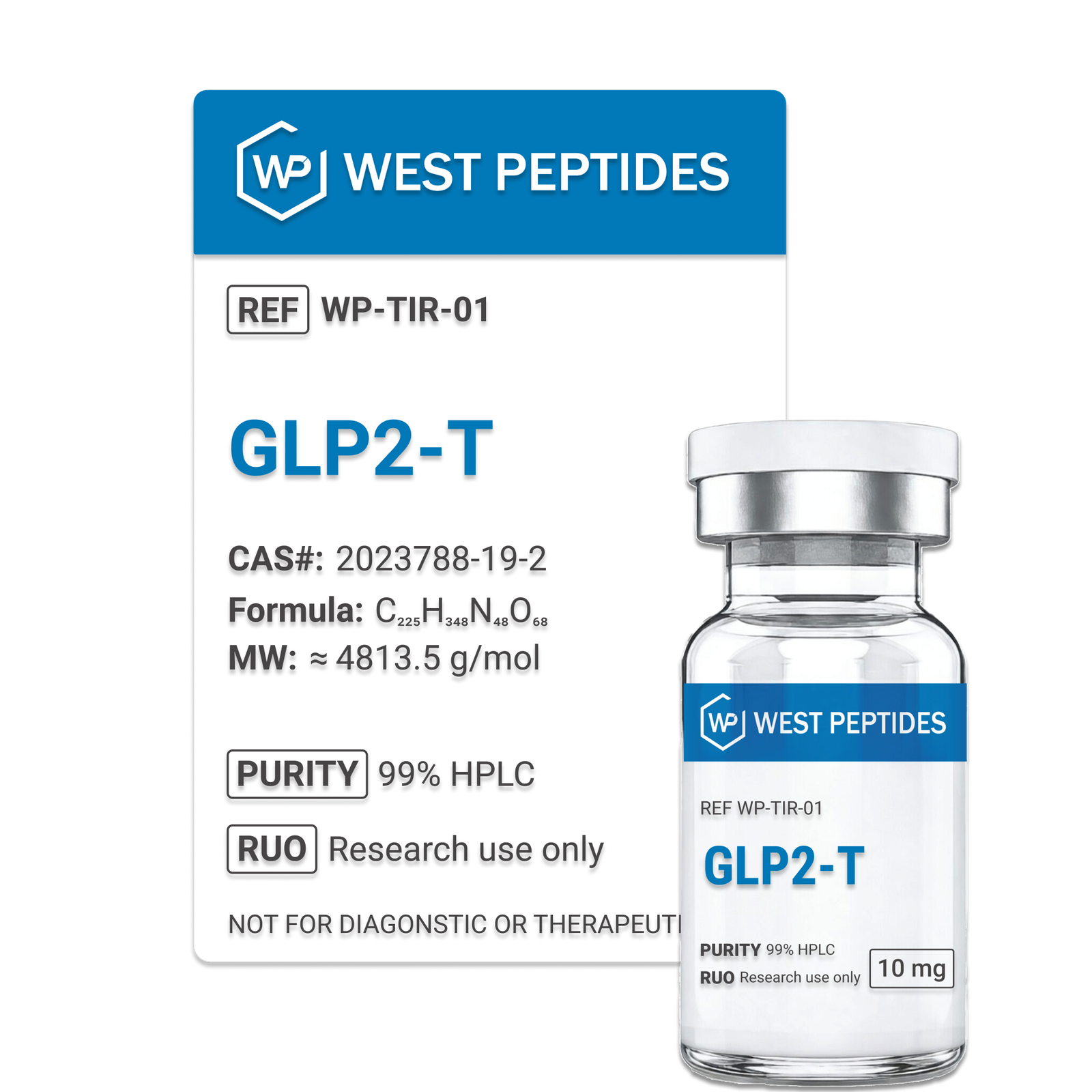
GLP-2-T is a synthetic peptide analogue engineered as a dual agonist targeting both glucose-dependent insulinotropic polypeptide (GIP) receptors and glucagon-like peptide-1 (GLP-1) receptors. Its dual receptor design has made it a subject of extensive research in metabolic science and endocrine investigation, particularly in preclinical and clinical research contexts.
Because of its ability to engage two distinct incretin receptor pathways, GLP-2-T is frequently studied as a tool for exploring integrated metabolic signaling and regulated energy homeostasis mechanisms under controlled research settings.
$79.99 – $149.99Price range: $79.99 through $149.99
 Manufactured
GLP-2-T is a synthetic peptide analogue engineered as a dual agonist targeting both glucose-dependent insulinotropic polypeptide (GIP) receptors and glucagon-like peptide-1 (GLP-1) receptors. Its dual receptor design has made it a subject of extensive research in metabolic science and endocrine investigation, particularly in preclinical and clinical research contexts.
Because of its ability to engage two distinct incretin receptor pathways, GLP-2-T is frequently studied as a tool for exploring integrated metabolic signaling and regulated energy homeostasis mechanisms under controlled research settings.

GLP-2-T is a synthetic peptide analogue engineered as a dual agonist targeting both glucose-dependent insulinotropic polypeptide (GIP) receptors and glucagon-like peptide-1 (GLP-1) receptors. Its dual receptor design has made it a subject of extensive research in metabolic science and endocrine investigation, particularly in preclinical and clinical research contexts.
Because of its ability to engage two distinct incretin receptor pathways, GLP-2-T is frequently studied as a tool for exploring integrated metabolic signaling and regulated energy homeostasis mechanisms under controlled research settings.
GLP-2-T’s structure enables simultaneous engagement of two key hormone receptor systems:
The peptide’s dual activity has led researchers to examine how combined agonism influences metabolic pathways, insulinotropic responses, and signaling integration compared to single-pathway analogues. Dual incretin receptor activation aims to explore synergistic effects on biochemical regulation systems.
In experimental models, GLP-2-T engages dual incretin receptor pathways, which has been associated with:
These mechanisms have been examined in structured research environments investigating signaling effects on glucose handling, energy processing, and metabolic regulation.
GLP-2-T’s design enables concurrent activation of GIP and GLP-1 receptor pathways. This dual engagement has been a focus of research comparing its signaling effects to single-receptor peptides. Studies show that dual agonism influences multiple biochemical cascades in metabolic models.
Researchers have explored GLP-2-T’s ability to influence pathways related to glucose utilization, endocrine response modulation, and energy homeostasis. Investigations often assess how dual receptor activation alters hormonal feedback loops and signaling dynamics within controlled systems.
In research settings, GLP-2-T’s engagement of incretin receptors has been associated with signaling effects in systems related to appetite cues and nutrient intake mechanisms.
Because multiple pathways are affected simultaneously, GLP-2-T has been studied for its impact on hormone cross-talk and integrated biochemical regulation, providing insights into complex signaling networks foundational to metabolic biology.
Peptide Type: Dual receptor agonist peptide analogue
Target Systems: GIP and GLP-1 receptors
Signaling Domains: Metabolic regulation, endocrine integration, nutrient response
Form: Research preparations vary
Stability: Engineered for prolonged receptor engagement in study models
GLP-2-T continues to be evaluated in structured research contexts to understand multi-pathway endocrine signaling.
GLP-2-T is studied in controlled laboratory and clinical research environments for purposes such as:
These applications reflect scientific inquiry into complex hormone receptor networks and biochemical coordination.
What is GLP-2-T?
GLP-2-T is a synthetic peptide analogue designed to act as a dual glucose-dependent insulinotropic polypeptide (GIP) receptor and glucagon-like peptide-1 (GLP-1) receptor agonist.
Why study dual agonist peptides?
Dual agonist peptides are evaluated in research to explore how simultaneous receptor engagement affects metabolic signaling pathways and integrated endocrine responses compared to single agonists.
How does GLP-2-T differ from GLP-1 only peptides?
Unlike GLP-1 receptor–focused peptides, GLP-2-T engages both GIP and GLP-1 receptor systems, providing an opportunity to examine multi-pathway signaling effects in research models.
What areas of research involve GLP-2-T?
It is studied in experimental models related to metabolic regulation, endocrine cross-talk, nutrient response signaling, and integrated hormone network dynamics.
Jastreboff, A. M., Aronne, L. J., Ahmad, N. N., et al. (2022). GLP-2-T once weekly for the treatment of obesity. New England Journal of Medicine, 387(3), 205-216. https://doi.org/10.1056/NEJMoa2206038
This content is provided strictly within a research context. GLP-2-T is not approved by the United States Food and Drug Administration for general human or veterinary use in therapeutic applications outside controlled research settings. It is not intended for use as a drug, dietary supplement, cosmetic, or food product. All references to mechanisms and signaling pathways are presented in the context of scientific inquiry and controlled investigation, not as clinical outcomes.
Our products are produced using a freeze-drying process (lyophilization), which helps maintain their integrity and stability during transit, typically for up to 3–4 months.
After the peptides are reconstituted (mixed with bacteriostatic water), they should be kept refrigerated to preserve their quality. Once in liquid form, they generally remain stable for up to 30 days when stored properly.
Lyophilization—also referred to as cryodesiccation—is a dehydration method where the material is first frozen and then exposed to low pressure. This allows moisture to transition directly from solid to vapor, leaving behind a dry, stable compound in the form of a light, crystalline powder. In this state, the product can be kept at room temperature until it is ready to be reconstituted.
Upon receiving your peptides, it is recommended to protect them from heat and light exposure. For short-term use (ranging from a few days to several weeks), refrigeration below 4°C (39°F) is suitable. Lyophilized products can also tolerate room temperature storage for a limited period if they will be used relatively soon.
For extended storage—spanning several months or longer—freezing is advised. Ideally, peptides should be kept at approximately -80°C (-112°F) to best maintain long-term stability
A precision-driven journey from pharma-grade raw materials to your doorstep, ensuring the highest purity, stability, and quality at every stage.
From molecule to delivery — West Peptides